 xdexygnr@gmail.com
The Problem No One Talks About at the Business Meeting
Picture this: A potential customer in Riyadh searches for your product at 9 PM on their iPhone. Your competitor’s website loads in two seconds — clean, fast, easy to browse. Yours takes eight seconds, the text is tiny, buttons are hard to tap, and the phone number is not even clickable.
They call your competitor.
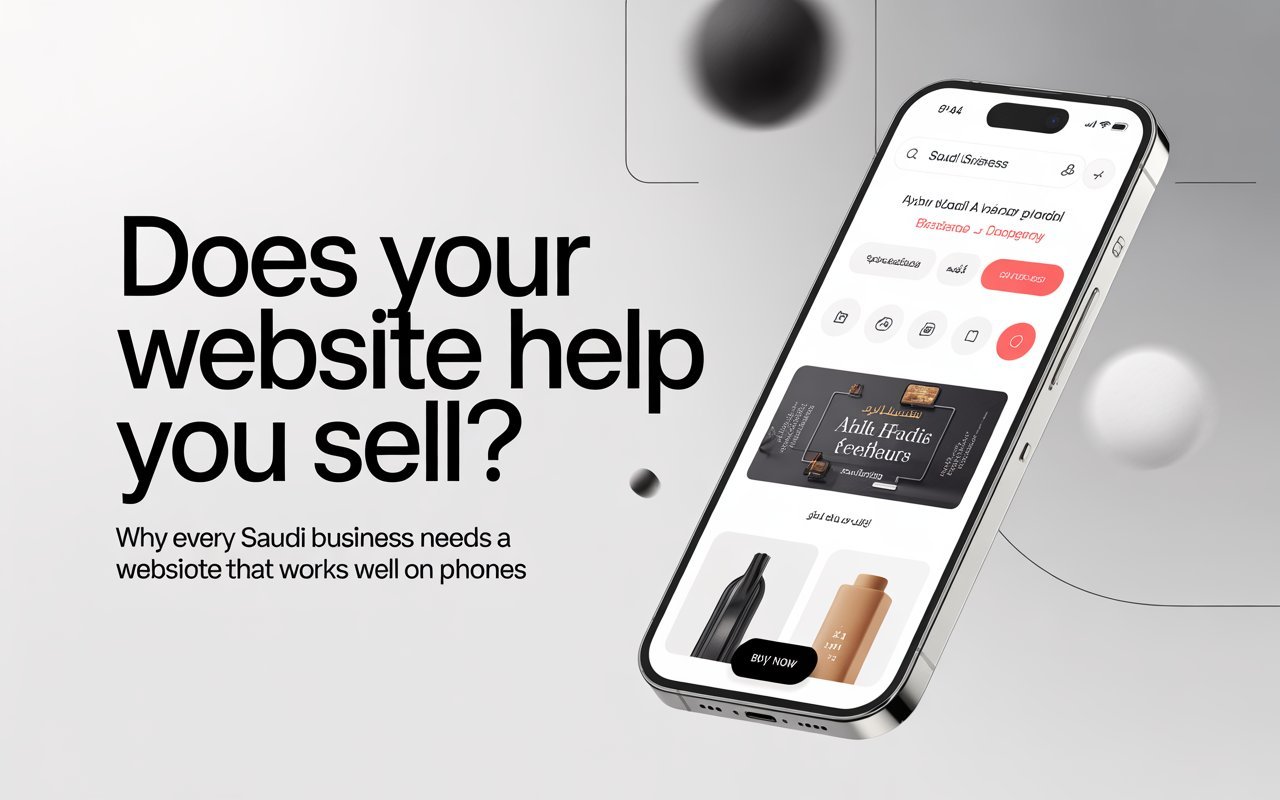
This is not a hypothetical. It is the daily reality for thousands of Saudi businesses that invested in a website years ago and assumed the work was done. It was not. A website is not a digital brochure you print once. It is a living sales tool — and for most industries in Saudi Arabia right now, that tool is being used almost exclusively on a mobile phone.
According to DataReportal’s 2024 Saudi Arabia Digital Report, over 97% of internet users in the Kingdom access the web via mobile devices. Saudi Arabia also has one of the highest smartphone penetration rates in the entire Middle East. If your website was not built mobile-first, or if it has not been updated in the last two to three years, you are almost certainly losing business you never knew you had.
This article walks you through exactly why mobile performance matters, what a high-performing business website actually looks like in 2025, how to evaluate your current situation, and what to look for when choosing a website development company in Saudi Arabia.
What Does “A Website That Works” Actually Mean?
Before diving into features and frameworks, we need to reframe what a business website is supposed to do.
Most business owners think of a website as:
- A place to list their services
- A way to look professional
- Something they needed to have
High-performing businesses treat their website as:
- Their best salesperson (available 24/7, in every city simultaneously)
- The foundation of their digital credibility
- A system that captures leads, answers questions, and moves people toward a purchase decision
The difference between those two mindsets is enormous — and it shows up directly in revenue.
A website that “works” is one that:
- Loads fast on any mobile connection, including 4G in areas with moderate signal
- Communicates clearly what you do and who you serve, within the first five seconds
- Makes it easy to take action — call, WhatsApp, fill a form, get directions
- Builds trust through testimonials, certifications, case studies, or visual proof
- Shows up in search when people are looking for what you offer
- Converts visitors into inquiries at a measurable rate
None of that is complicated in concept. All of it requires deliberate execution.
The Mobile-First Reality in Saudi Arabia
Saudi Arabia is not a developing mobile market. It is one of the most mobile-forward markets in the world, shaped by several unique factors.
High smartphone adoption combined with urban density means that consumers in Jeddah, Riyadh, Dammam, and Mecca move fast. They search, evaluate, and decide quickly — often in a single browsing session while commuting, waiting, or on a break.
WhatsApp integration is expected. In the Saudi market specifically, a website without a visible WhatsApp click-to-chat button is considered incomplete. Customers expect to move from website to conversation in one tap.
Arabic language support is not optional for many sectors. Retail, real estate, hospitality, healthcare, and government-adjacent services all need to communicate fluently in Arabic — with proper right-to-left layout, appropriate fonts, and culturally appropriate design language.
Google and social media drive discovery. Saudi users rely heavily on Google Search, Instagram, Snapchat, and TikTok to find businesses. Your website must perform well in both search and social referral traffic — meaning fast load times and visually sharp landing pages.
If your current website was built without these realities in mind, it is not just outdated — it is actively working against you every time someone searches for your category.
Core Attributes of a High-Performing Business Website
Understanding what separates a functional website from a revenue-generating one comes down to eight core attributes. These are the benchmarks used by professional web development companies in Saudi Arabia when auditing and rebuilding client sites.
1. Mobile Responsiveness (True, Not Technical)
There is a difference between a website that is technically responsive and one that is actually pleasant to use on a phone. Technical responsiveness means the layout adjusts to screen size. Real mobile optimization means:
- Text is readable without zooming
- Buttons are large enough to tap with a thumb
- Forms have large input fields and minimal required fields
- Navigation menus are intuitive on small screens
- Images load at the right size for mobile bandwidth
Many older websites were made “responsive” by adding a few CSS breakpoints. That is not enough. A mobile-first redesign starts from the phone screen and builds upward — not the other way around.
2. Page Speed and Core Web Vitals
Google officially uses page experience signals — including Largest Contentful Paint (LCP), First Input Delay (FID), and Cumulative Layout Shift (CLS) — as ranking factors. These are collectively known as Core Web Vitals.
For Saudi businesses, the practical target is:
- Full page load under 3 seconds on mobile (ideally under 2)
- LCP under 2.5 seconds
- Minimal layout shift as page elements load
Slow websites do not just rank lower. They lose visitors. Research consistently shows that a one-second delay in page load time reduces conversions by approximately 7%. For a business generating 50 inquiries a month through its website, that is a measurable and avoidable loss.
3. Clear Value Proposition Above the Fold
The first thing a visitor sees without scrolling — the “above the fold” section — must answer three questions within five seconds:
- What do you do?
- Who do you do it for?
- What should I do next?
If your homepage opens with a generic stock photo and a tagline like “Excellence in Everything We Do,” you are losing people before they even begin.
Strong above-the-fold sections use:
- A direct headline stating your core service and location
- A subheadline explaining a key benefit or differentiator
- A primary call-to-action (Call, WhatsApp, Get a Quote)
- A secondary trust signal (years in business, number of clients, key certification)
4. WhatsApp and Direct Contact Integration
As mentioned earlier, this is non-negotiable for Saudi businesses. The WhatsApp Business API integration should be:
- A floating button visible on all pages
- Pre-filled with an opening message to reduce friction
- Connected to an active, monitored WhatsApp Business number
Additionally, phone numbers should be click-to-call. Email addresses should be click-to-email. Physical addresses should link directly to Google Maps or Waze directions.
Every unnecessary step between interest and contact costs you leads.
5. Bilingual Capability (Arabic + English)
The appropriate language balance depends on your audience. A luxury real estate developer serving international investors may weight English more heavily. A local retail shop or healthcare clinic serving Saudi families may need primarily Arabic.
What matters is that the chosen language — or both languages — is implemented correctly. Arabic websites require:
- RTL (right-to-left) layout
- Arabic-optimized typefaces (not just translated text in a Latin font)
- Culturally appropriate imagery and color use
- Separate SEO optimization for Arabic keyword sets
Poor Arabic implementation is often worse than no Arabic at all, as it signals carelessness to the exact audience you are trying to reach.
6. Search Engine Visibility (On-Page SEO Foundation)
A beautiful website that no one finds is a missed opportunity. On-page SEO is the foundation that ensures search engines understand your content and match it to relevant queries.
This includes:
- Proper use of title tags and meta descriptions
- Header hierarchy (H1, H2, H3) structured around target topics
- Local SEO signals — business name, address, phone number consistently formatted
- Google Business Profile integration and optimization
- Schema markup for business type, reviews, and services
- Image alt text and file naming
Many web development companies in Jeddah now offer combined web development and SEO packages because building a site without SEO fundamentals baked in requires expensive retrofitting later.
7. Trust Architecture
Online trust is built through specific, verifiable signals. For Saudi businesses, these typically include:
- Client logos (with permission)
- Before/after case studies or project portfolios
- Video testimonials or written reviews (Google reviews embeds work well)
- Awards, certifications, or memberships in industry bodies
- Team photos with real names and roles
- Physical address and registration information
Businesses that display trust signals convert at significantly higher rates than those without. It is not vanity — it is the digital equivalent of a clean, well-staffed physical office.
8. Analytics and Conversion Tracking
You cannot improve what you do not measure. A professionally built website includes:
- Google Analytics 4 setup with goal tracking
- Google Search Console integration
- Conversion event tracking (form submissions, WhatsApp clicks, calls)
- Heatmap tools (such as Hotjar or Microsoft Clarity) to understand user behavior
Without these, you are flying blind. With them, you can identify exactly where visitors drop off, which pages drive the most inquiries, and which traffic sources deliver the best customers.
Industries in Saudi Arabia That Benefit Most from Mobile-Optimized Websites
While every business benefits from a strong mobile web presence, certain sectors in the Kingdom see disproportionately high impact.
Real Estate and Property Development Saudi buyers research extensively online before contacting agents. A slow or visually poor website for a property developer immediately undermines confidence in the product being sold. 3D tour integration, project galleries, and WhatsApp inquiry forms are now baseline expectations in this sector.
Healthcare Clinics and Medical Centers Patients search for doctors and clinics urgently, often on mobile. Clear display of specialties, doctor profiles, and a one-tap appointment booking or WhatsApp link can make the difference between gaining and losing a patient.
Restaurants and Food & Beverage With Zomato and Talabat dominant for delivery, a restaurant’s own website needs to serve a different purpose — brand building, franchise inquiries, catering requests, and venue bookings. Mobile performance here is critical because diners often search from their table or while traveling.
E-Commerce and Retail Saudi Arabia’s e-commerce market continues growing rapidly. Mobile-optimized product pages, fast checkout flows, and seamless payment gateway integration (including Mada, Tabby, and Tamara) are the difference between a cart abandonment and a completed sale.
Professional Services (Law, Consulting, Accounting) High-trust, high-value services depend on credibility signals more than others. A professionally designed website with team profiles, client case studies, and clear service descriptions builds the confidence that leads to initial consultations.
Construction, Contracting, and Engineering Vision 2030 has created a surge in construction activity. Contractors and engineering firms competing for projects — from SME clients to government-adjacent work — are finding that a well-structured, fast-loading portfolio site opens doors that previously required only word-of-mouth.
What to Look for When Choosing a Website Development Company
This is where many business owners make costly mistakes — either choosing on price alone, or being impressed by a sales pitch that does not translate to actual results.
Here is what genuinely matters when evaluating web development companies in Saudi Arabia:
Portfolio Depth and Industry Relevance
Ask to see live examples of websites they have built, specifically in your industry or a comparable one. Do not just look at screenshots — visit the actual URLs and test them on your phone. How fast do they load? How easy are they to navigate?
Understanding of the Saudi Market
A web development company that has worked primarily with international clients may not understand the importance of WhatsApp integration, Arabic RTL design, local SEO for Saudi cities, or Mada payment gateway requirements. Market-specific knowledge matters enormously.
Full-Service Capability vs. Design-Only
Some companies are primarily design studios. Others offer full development including backend systems, CRM integrations, e-commerce platforms, and ongoing technical maintenance. Know what you need before you engage.
SEO Integration from Day One
Ask directly: “Will my website be SEO-ready when it launches?” If the answer involves additional fees for “a separate SEO package,” be cautious. On-page SEO foundations should be part of any professional web development project, not an afterthought.
Post-Launch Support and Maintenance
Websites require ongoing updates — security patches, content changes, performance monitoring, Google algorithm adaptation. What happens after launch? What is the support structure? What are the maintenance costs?
Communication and Project Management
Building a website involves repeated back-and-forth. How does the company communicate? Do they use a project management tool? What is their typical turnaround on revisions? Clear processes here prevent months of frustrating delays.
Transparent Pricing Structure
Beware of very low quotes. They often exclude content, SEO setup, hosting configuration, email setup, or revision rounds. Ask for a detailed scope of work before comparing prices across providers.
How the Website Development Process Actually Works
For business owners who have never commissioned a professional website, here is an honest overview of how a well-run project typically unfolds.
Phase 1: Discovery and Strategy (1–2 weeks) The agency learns about your business, target audience, competitors, and goals. You define the pages needed, key calls to action, and success metrics. This phase should produce a clear project brief and sitemap.
Phase 2: Design (2–3 weeks) Visual mockups are created — typically starting with the homepage and one or two key interior pages. You review and request revisions before any development begins. This is where brand alignment, typography, color, and layout are established.
Phase 3: Development (3–6 weeks) The approved designs are built into a functioning website. This includes backend setup, mobile optimization, speed optimization, form functionality, WhatsApp integration, payment gateways if applicable, and content management system configuration.
Phase 4: Content and SEO Setup (1–2 weeks) Content is added — text, images, video embeds. On-page SEO elements are finalized: title tags, meta descriptions, schema markup, local SEO data, Google Analytics and Search Console setup.
Phase 5: Testing and Launch (1 week) The site is tested across devices, browsers, and connection speeds. Forms, buttons, and conversion paths are tested. The site is then launched, either replacing an existing site or going live for the first time.
Phase 6: Post-Launch (Ongoing) Performance is monitored. Search visibility is tracked. Improvements are made based on data. Content is updated regularly to maintain search relevance.
A realistic timeline for a professional business website from kickoff to launch is 8 to 14 weeks, depending on complexity, content readiness, and revision cycles.
Frequently Asked Questions
Q1: How much does it cost to build a professional business website in Saudi Arabia?
Website development costs in Saudi Arabia vary considerably based on scope, complexity, and the agency you choose. A basic service business website — five to eight pages, mobile-optimized, with SEO foundations — typically ranges from SAR 8,000 to SAR 25,000. A mid-tier website with custom design, Arabic/English bilingual support, and integrations (WhatsApp, CRM, forms) commonly falls between SAR 25,000 and SAR 70,000. E-commerce websites or enterprise-grade platforms with payment gateways, product catalogues, and backend dashboards can range from SAR 70,000 upward depending on the feature set.
The most important thing to understand is that a website is not just a cost — it is an asset. A site generating 20 qualified inquiries per month, each potentially worth SAR 5,000 or more, pays for itself within weeks of launch if built correctly.
Q2: What is the difference between a mobile-responsive website and a mobile-first website?
Mobile-responsive means a website built for desktop that has been modified to adjust its layout for smaller screens. Mobile-first means the website was designed and built starting from the mobile experience, then expanded for desktop. The practical difference is significant. Mobile-responsive sites often carry unnecessary code and design decisions that make them slower and harder to use on phones. Mobile-first sites are leaner, faster, and more intuitive for mobile users — which, in Saudi Arabia, is the majority of your audience.
Q3: How long does it take to see results after launching a new website?
SEO-driven results — appearing in Google search for target keywords — typically take three to six months to materialize, depending on competition in your sector and how consistently you publish relevant content. Conversion improvements (more inquiries from existing traffic) can be seen within days or weeks of launching a faster, clearer, better-designed site. Paid traffic results via Google Ads or social ads are immediate once campaigns are live. A well-built site improves results across all channels simultaneously.
Q4: Do I need a separate Arabic website or can one website handle both languages?
You do not need two separate websites. A well-built bilingual website uses a single platform with language-switching functionality that serves both Arabic and English content from the same domain. This is better for SEO (all traffic authority consolidates on one domain), better for maintenance (you update one system), and better for the user experience. The key is that the Arabic version must be a real translation with proper RTL layout — not just auto-translated text dropped into a left-to-right template.
Q5: What questions should I ask a web development company before hiring them?
The most revealing questions to ask a potential web development partner are: Can you show me live websites you have built in my industry? How do you handle SEO during development — is it included? Who owns the website and all its content when the project is complete? What is your post-launch maintenance offering and what does it cost? How do you communicate during the project and what is your revision policy? What happens if the website has technical problems after launch?
A company that answers these questions clearly, specifically, and without hesitation is generally one that has built processes around client success. Vague or evasive answers to any of these warrant caution.
Q6: Can a website actually generate sales without running paid ads?
Yes — and for many Saudi businesses, organic search is their most cost-effective lead channel over the medium and long term. A website optimized for relevant local search terms (for example, “civil engineering contractor Jeddah” or “dermatology clinic Riyadh”) can attract genuinely high-intent visitors who are actively looking to buy. The investment is in building the website correctly and maintaining content quality over time. Unlike paid ads, there is no cost-per-click. Once you rank well organically, that traffic is effectively free and compounds as your domain authority grows.
Q7: What is the biggest mistake Saudi businesses make with their websites?
The single biggest mistake is launching a website and then treating it as finished. Websites that are not updated, technically maintained, and regularly improved lose search rankings, accumulate broken links, fail on new device types, and gradually fall behind competitors who are actively investing. A website should be reviewed strategically at least twice a year, with content updates, performance checks, and alignment to any changes in your service offering or target audience. The second biggest mistake is choosing a development partner based solely on the lowest price, without evaluating their actual capabilities or results.
Choosing the Right Web Development Partner in Saudi Arabia
If you have made it this far, you now understand more about what a high-performing business website actually requires than most of your competitors do. That knowledge gap is an advantage — but only if you act on it.
The web development companies in Jeddah and across Saudi Arabia vary enormously in their capabilities, their understanding of the local market, and their genuine commitment to client outcomes. Some are large agencies with deep teams and proven portfolios. Others are smaller studios that offer more personalized attention and faster communication. Both can deliver excellent results if the fit is right.
What matters most is not the size of the agency — it is whether they genuinely understand your business goals, whether they have demonstrated results in your sector, and whether they approach your website as a commercial asset rather than a design project.
The Saudi digital economy is expanding rapidly. Vision 2030 is accelerating digital infrastructure investment. Consumer expectations are being shaped by world-class apps and global e-commerce platforms. The window to establish digital authority in your category is real — and businesses that invest in professional, mobile-optimized, search-visible websites now will hold positions that become harder for competitors to displace over time.
Conclusion: Your Website Is Either Working or It Isn’t
There is no neutral state. Every day your website is slow, hard to use on mobile, or invisible in search is a day where potential customers are finding your competitors instead of you. And unlike a missed phone call or a slow salesperson, a poor website operates at scale — it fails thousands of potential customers simultaneously, silently, without anyone ever telling you.
The businesses growing fastest in Saudi Arabia right now — across real estate, healthcare, retail, professional services, and construction — are the ones treating their website as the center of their digital strategy, not an afterthought.
If you are unsure whether your website is helping you sell, test it right now. Open it on your phone. How fast did it load? Was the text readable without zooming? Could you find your phone number and tap it in under five seconds? Did it make you want to call?
If the answer to any of those is no, you have your next business priority.
The good news is that working with the right website development company in Saudi Arabia, this is a solvable problem — and the investment pays for itself faster than most business owners expect.