 xdexygnr@gmail.com
Introduction: The $1.5 Billion Problem No Festival Wants to Talk About
Every summer, tens of millions of people buy tickets to music festivals, sporting events, and large-scale cultural gatherings. And every summer, a quiet war is fought at the gates.
Ticket fraud is not a fringe problem. The global secondary ticketing and counterfeit market costs the live events industry an estimated $1.5 billion annually. At major festivals — where single-day capacity can exceed 80,000 attendees — even a 2% fraud rate means thousands of people walking through gates on fake credentials. The damage is not just financial. It is reputational, logistical, and in high-density environments, it can become a genuine safety issue.
For years, the industry leaned on paper tickets, basic barcodes, and visual checks. That era is over.
The new standard is secure wristband printing — a system that combines on-demand physical identification with digital verification layers like RFID chips and QR encoding. When implemented correctly, it does not just stop fraud at the gate. It closes every gap a counterfeiter could exploit before, during, and after an event.
This article breaks down exactly how secure wristband printing works, why it has become indispensable for high-profile events, what separates a good system from a great one, and how event organizers can deploy it without friction.
What Is Secure Wristband Printing?
Secure wristband printing is an on-demand identification system in which event wristbands are produced, encoded, and issued at or near the point of entry — rather than pre-manufactured and mailed in bulk.
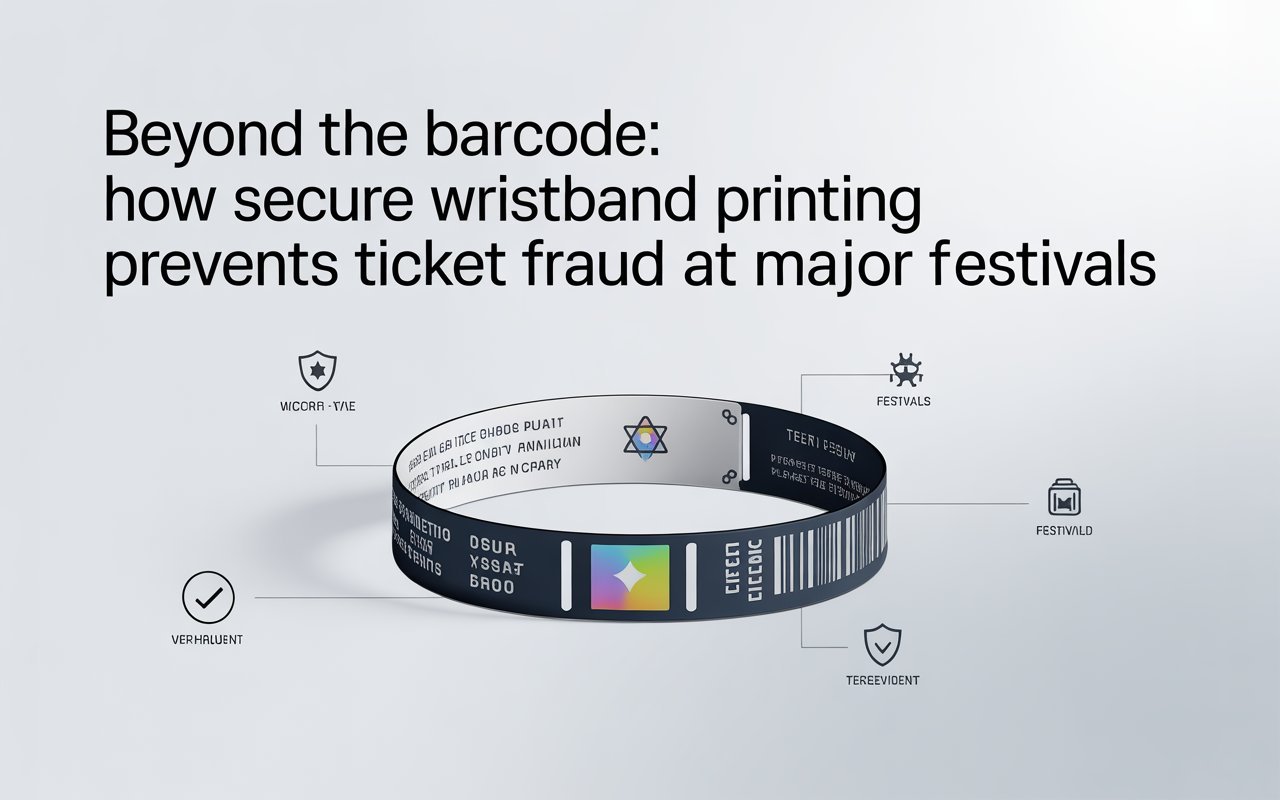
Each wristband is printed with a combination of:
- A unique barcode or QR code tied to a verified ticket record
- Encoded RFID or NFC chip data for contactless scanning
- Tamper-evident materials that self-destruct if removed
- Event-specific visual security features (holograms, UV ink, micro-text)
- Attendee-specific data printed on the band itself (name, ticket tier, date)
The critical difference from traditional wristbands is real-time integration. The wristband is not just a physical object — it is a live credential. It is generated only when a valid ticket is confirmed, and its embedded data is synchronized with the event’s access control system at the moment of issuance.
This means a counterfeiter cannot replicate the wristband without also replicating the database entry — which they cannot access.
The Security Stack: Core Attributes and Features
Understanding what makes secure wristband printing effective requires looking at each layer of the security architecture individually. These are not redundant features. They are interdependent defenses.
1. On-Demand Printing (The First Lock)
Traditional pre-printed wristbands are manufactured weeks before an event and distributed through mail or box offices. That window — between production and the event — is where fraud begins. Bands can be photographed, replicated, or intercepted.
On-demand printing eliminates that window entirely. The wristband does not exist until the attendee presents valid credentials. There is no inventory of “blank” bands to steal or copy. The moment of printing is the moment of verification.
Modern on-demand printers used in festival environments can produce a finished, encoded wristband in under three seconds, making them viable even for high-throughput entry gates.
2. RFID Integration (The Second Lock)
RFID (Radio Frequency Identification) chips embedded in wristbands represent the most significant evolution in event access control in the last decade.
Here is how they function in practice:
- UHF RFID (used in large outdoor festivals) allows hands-free scanning at distances of up to several meters — ideal for fast-moving crowd flow
- HF RFID / NFC (used for cashless payments and VIP zones) requires close proximity, adding a deliberate interaction layer for sensitive access points
- Each chip contains a unique identifier written at the moment of printing, synchronized to the event database
- Once a band is scanned and validated, the record is flagged — preventing the same credential from being accepted at another entry point simultaneously
The simultaneous-use detection is one of the most powerful anti-fraud mechanisms available. Even if someone managed to clone a wristband’s visual appearance perfectly, the system would reject the duplicate the moment the original was scanned anywhere on-site.
3. Tamper-Evident Materials (The Third Lock)
The physical wristband itself is engineered to resist transfer and reuse:
- Tyvek bands tear immediately and irreparably if removal is attempted
- Vinyl bands with security closures use one-way locking mechanisms that cannot be reopened without cutting
- Woven fabric bands include heat-sealed or snap closures with embedded tear indicators
- UV-reactive inks print invisible verification marks readable only under black light — invisible to anyone attempting to replicate the band without professional equipment
Some premium systems add thermochromic ink elements that change color when touched or exposed to heat — making static photocopies immediately identifiable as fraudulent.
4. Visual Security Layers (The Fourth Lock)
Beyond electronic verification, trained staff can visually authenticate secure wristbands using:
- Holographic overlaminates that shift color under light and cannot be photocopied
- Micro-text printing (text below 0.5mm that is invisible to the naked eye but verifiable under magnification)
- Sequential serial numbering with check-digit validation
- Event-specific watermarks or patterns embedded in the substrate
These visual features serve a dual purpose: they deter would-be counterfeiters who lack the printing equipment, and they give security personnel a fast, tool-free verification method when scanners are unavailable.
5. Cloud-Synchronized Access Control (The Fifth Lock)
Every element above operates within a broader access control ecosystem. The most robust implementations connect wristband issuance and scanning to a cloud-based event management platform that provides:
- Real-time entry logs with timestamps and gate identifiers
- Capacity monitoring per zone or stage
- Instant blacklist updates (for lost/stolen tickets)
- Offline mode with sync-on-reconnect for areas with poor connectivity
- Audit trails for post-event security review
Real-World Applications: Where Secure Wristband Printing Delivers
Major Music Festivals
Coachella, Glastonbury, Lollapalooza — events of this scale cannot afford even minor fraud vulnerabilities. A single viral story about counterfeit wristbands walking into a sold-out headline set damages brand trust for years.
At events with multiple stages, VIP areas, backstage zones, and camping sections, secure wristbands serve as a multi-zone access passport. One band, properly tiered and encoded, tells the access control system exactly where each attendee is authorized to go — and where they are not.
RFID also enables cashless payment integration at these events, linking the wristband to a pre-loaded or credit-linked payment account. This reduces cash fraud, speeds up vendor transactions, and creates detailed spending data that benefits both organizers and sponsors.
Sporting Events and Stadium Concerts
For one-day events with a single performance, the priority shifts to gate throughput — getting tens of thousands of people inside in a narrow pre-show window without bottlenecks.
On-demand printing stations positioned at entrance clusters can process wristband issuance rapidly without slowing entry flow. UHF RFID scanning at turnstiles enables contactless, near-instantaneous validation.
Corporate Events and Conferences
Multi-day professional events use secure wristbands to manage:
- Session access control (ensuring only registered attendees enter keynotes and workshops)
- Tiered credentialing (speaker vs. attendee vs. press vs. exhibitor)
- Networking features (RFID-enabled digital business card exchange)
- Meal and beverage entitlements tracked per scan
VIP and Hospitality Experiences
For premium-tier experiences — artist lounges, hospitality suites, private club sections — the margin for error is zero. Wristbands for these zones typically include additional visual differentiation alongside enhanced RFID encoding to ensure that upselling from general admission is physically impossible, not just procedurally discouraged.
Secure Wristband Printing vs. Traditional Methods: A Direct Comparison
| Feature | Paper Tickets | Pre-Printed Wristbands | Secure Wristband Printing |
| Counterfeit difficulty | Low | Medium | Very High |
| On-site replication risk | High | Medium | Near Zero |
| Simultaneous-use detection | No | No | Yes (RFID) |
| Cashless payment integration | No | Rarely | Yes |
| Multi-zone access control | No | Limited | Yes |
| Tamper evidence | None | Basic | Advanced |
| Real-time database sync | No | No | Yes |
| Speed of issuance | Instant (pre-made) | Instant (pre-made) | 2–4 seconds |
| Post-event audit data | Minimal | Minimal | Comprehensive |
The trade-off in issuance speed (2–4 seconds vs. instant for pre-made options) is negligible when weighed against the security and operational advantages. High-capacity printing stations running in parallel at multiple entry gates maintain throughput without meaningful delay.
Implementation Overview: From Setup to Gate
Deploying secure wristband printing at a major event is a structured process, not a last-minute decision. Here is a realistic implementation pathway:
Phase 1 — System Design (6–8 Weeks Before Event)
- Select wristband material type based on event duration, weather conditions, and security requirements
- Define access tiers (general, VIP, backstage, camping, etc.) and assign RFID encoding schemas
- Integrate wristband issuance software with ticketing platform (API or direct integration)
- Configure access control rules per zone
Phase 2 — Hardware Procurement and Testing (4–6 Weeks Before)
- Deploy on-demand wristband printers — typically thermal-transfer or direct-thermal models compatible with RFID inlay insertion
- Test RFID reader coverage at all entry and internal checkpoints
- Run end-to-end simulation with mock ticket data to verify scan-to-issuance workflow
Phase 3 — Staff Training (2–3 Weeks Before)
- Train gate staff on wristband printer operation, error handling, and visual authentication
- Brief security personnel on RFID scanner use and what system alerts mean
- Establish escalation procedures for suspected fraudulent credentials
Phase 4 — Event Day Operations
- Open issuance stations 2–3 hours before doors for early arrival processing
- Monitor real-time entry dashboards for anomalies (duplicate scans, unusual cluster arrivals, system alerts)
- Maintain backup procedures for network interruption or hardware failure
Phase 5 — Post-Event Audit
- Export full entry logs for capacity and dwell-time analysis
- Review any flagged events (duplicate attempts, overrides) for security review
- Use data to improve zone allocation and gate staffing for future events
Frequently Asked Questions
Q1: How does RFID wristband technology actually stop duplicate ticket fraud at festivals?
Each RFID chip is assigned a unique identifier at the moment of wristband issuance, and that identifier is written to a live event database. When a wristband is scanned at any entry or internal checkpoint, the system marks that credential as used. If anyone attempts to use a second wristband with the same credential — even a physically perfect copy — the system flags the duplicate in real time and denies access. No human judgment is required; the database enforces uniqueness automatically.
Q2: Can secure wristbands work without internet connectivity on-site?
Yes. Professional-grade access control systems are built with offline-first architecture. Scanners cache a local copy of the valid credential list and can validate entries without a live connection. All scan events are logged locally and synced to the central database when connectivity is restored. This matters significantly for outdoor festivals in remote locations where cellular coverage is unreliable.
Q3: What is the difference between RFID and NFC in wristbands, and which is better for festivals?
RFID and NFC operate on the same underlying radio frequency principle, but at different frequencies and effective ranges. UHF RFID (used in most large festival entry systems) works at distances up to several meters, enabling fast, hands-free crowd flow at turnstiles. NFC is a short-range subset of HF RFID requiring close contact, typically used for cashless payment terminals and VIP access points where proximity confirmation is desirable. Many premium festival systems use both — UHF for entry gates, NFC for payment and zone control.
Q4: How tamper-evident are modern event wristbands, and can they be transferred between people?
This depends on the wristband material selected. Tyvek wristbands tear irreparably upon removal — there is no practical way to remove and re-apply them. Vinyl wristbands with one-way locking mechanisms similarly cannot be reopened without cutting. For fabric wristbands, heat-sealed or snap closures with embedded indicators show visible evidence of any tampering attempt. When combined with RFID — which verifies the chip rather than just the physical band — even a successful physical transfer does not grant access if the original credential was already scanned.
Q5: How long does it take to issue a secure wristband at a festival gate, and will it slow down entry?
Modern on-demand wristband printers produce a finished, encoded wristband in approximately two to four seconds per unit. When issuance stations are distributed across multiple entry lanes — typically one printer per two to three entry lanes at large events — throughput is comparable to barcode scanning alone. Many large festivals run parallel processing stations with pre-positioned queues that separate ticket verification from physical wristband issuance, further minimizing bottlenecks.
Q6: Can secure wristbands be used for cashless payments at festival vendors?
Yes, and this is one of the most commercially significant advantages of RFID wristband integration. Each wristband can be linked at issuance to a pre-loaded account or a payment card on file. Attendees tap their wristband at vendor terminals for near-instant transactions without handling cash or a phone. For festival organizers, this generates detailed, real-time spending data by zone and vendor — valuable for both operational planning and sponsor reporting.
Q7: What happens if an attendee loses their wristband mid-event?
Lost wristband protocols vary by organizer, but a secure system makes recovery possible in ways that paper tickets cannot offer. Because each wristband credential is tied to a unique ticket record — which is linked to a purchaser identity — event staff can locate the original credential, blacklist the lost band, and issue a replacement. Without RFID integration, a lost wristband is unrecoverable. With it, the credential follows the attendee, not the physical object.
Conclusion: The Wristband Is Not Decoration — It Is Infrastructure
Ticket fraud is not a problem that resolves itself through better enforcement or more diligent gate staff. It resolves through better systems — systems where the economics of fraud collapse because the attempt is guaranteed to fail, not just likely to be caught.
Secure wristband printing, built on on-demand issuance, RFID integration, and tamper-evident materials, is that system. It removes the window between ticket purchase and event entry where counterfeit credentials can be created. It eliminates simultaneous use through real-time database synchronization. It layers visual, electronic, and physical security in a way that defeats opportunistic and organized fraud alike.
For event organizers weighing the investment, the framing should not be “cost of secure wristbands vs. cost of basic wristbands.” The real framing is “cost of a secure system vs. cost of a fraud incident” — the reputational damage, the attendee complaints, the refund demands, the regulatory scrutiny, and the social media fallout that follows a high-profile counterfeit wristband story.