 xdexygnr@gmail.com
The Queue Problem No Entertainment Venue Can Afford to Ignore
Picture a Friday evening at one of Jeddah’s most popular family entertainment centers. The weekend rush begins at 6 PM. Within thirty minutes, a line of 40 families stretches from the box office toward the parking gate. Each transaction takes roughly three minutes. A child cries from boredom. Parents check phones. A family at the back of the queue gives up and leaves.
This is not a hypothetical. It is a recurring operational reality for entertainment operators across Saudi Arabia’s two largest urban markets — Jeddah and Riyadh. And as Vision 2030 accelerates the country’s entertainment sector from near-zero to one of the most aggressively expanding leisure markets in the Middle East, the cost of getting the customer entry experience wrong has never been higher.
Saudi Arabia’s General Entertainment Authority reports that the entertainment sector contributes over SAR 52 billion annually to the national economy, with projections pointing toward substantial expansion through the decade. Dozens of new experience-based venues, indoor theme parks, escape rooms, VR arcades, bowling alleys, trampoline parks, and cineplex-adjacent entertainment complexes are either open or under construction in Jeddah and Riyadh alone.
The operators leading this growth share one infrastructural decision in common: they are replacing or augmenting traditional staffed ticketing counters with self-service kiosks. Not as a cost-cutting experiment, but as a strategic customer experience investment.
What Is a Self-Service Kiosk? Defining the Entity Clearly
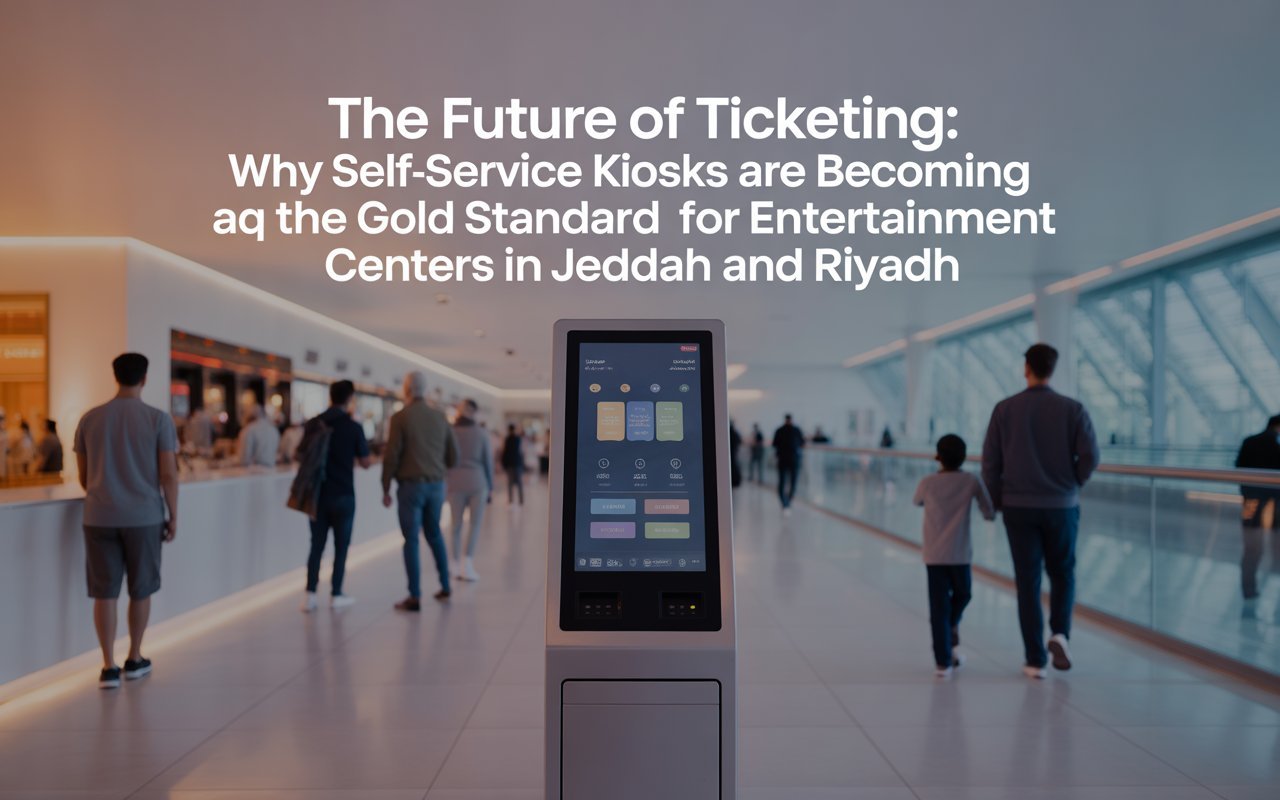
A self-service kiosk is a standalone, interactive terminal — typically a touchscreen-enabled unit — that allows customers to independently complete transactions, access information, or obtain services without requiring staff assistance at the point of interaction.
In the context of entertainment venues, a ticketing self-service kiosk performs functions that traditionally required a staffed counter: ticket selection and purchase, upsell of add-ons (meal packages, locker rentals, birthday packages), payment processing across multiple methods (cash, card, STC Pay, Apple Pay), QR code or wristband issuance, and booking management including pre-purchased online ticket collection.
The term “self-service kiosk” sits within a broader entity category that includes check-in kiosks (airports, hotels), ordering kiosks (restaurants), information kiosks (malls, government offices), and wayfinding kiosks. In entertainment specifically, the kiosk functions as the primary commercial interaction point — the equivalent of a cashier, upsell specialist, and ticketing agent rolled into one automated terminal.
Modern entertainment kiosks are distinct from the early generation of standalone ATM-style terminals from the 2000s. Today’s units integrate with cloud-based venue management software, support real-time inventory synchronization across channels, connect to CRM and loyalty program databases, and include hardware peripherals like biometric scanners, wristband dispensers, and receipt printers — all within a sleek physical housing designed for high-traffic environments.
Core Attributes and Features of Modern Entertainment Kiosks
Understanding what separates an effective kiosk deployment from a problematic one requires examining the feature architecture of well-built systems.
Multilingual Interface Support
In Jeddah and Riyadh, the guest mix at entertainment centers includes Saudi nationals, Arab expatriates, South Asian communities, Western expats, and international tourists. A kiosk that only presents Arabic or only presents English immediately creates a friction point for a significant portion of paying customers.
Leading systems offer Arabic-English bilingual interfaces as a baseline, with extensible support for Urdu, Hindi, Tagalog, and French. Saudi Vision 2030’s tourism targets make multilingual capability a commercial necessity, not a bonus feature.
Omnichannel Payment Integration
Saudi Arabia’s payment landscape has shifted dramatically. Cash remains relevant but card payments, STC Pay, Apple Pay, Google Pay, and MADA network transactions now represent the majority of consumer spending in urban entertainment contexts.
A capable kiosk system integrates with all major Saudi payment rails. This means PCI-DSS compliant card readers, NFC contactless terminals, QR code payment interfaces, and — critically — reliable MADA compatibility for debit transactions. Venues that restrict kiosk payments to cards or international wallets exclude a portion of their audience.
Real-Time Inventory and Capacity Management
For timed experiences — escape rooms, VR pods, laser tag sessions, bowling lanes — the kiosk must reflect live availability pulled from a central booking engine. A customer who purchases a 7:30 PM escape room slot only to discover on arrival that the room is double-booked will not return.
Cloud-connected inventory management with real-time synchronization across in-person kiosks, mobile apps, and website booking portals is the technical foundation of a reliable self-service experience.
Dynamic Upselling and Package Configuration
One of the most commercially significant attributes of modern kiosk software is intelligent upselling. Unlike a queue-pressured staff member who may skip the add-on pitch during busy periods, a kiosk presents upsell options consistently to every customer, every transaction.
For a family purchasing four standard entry tickets, the system might automatically surface: a birthday package upgrade (if a birthday date is detected from a profile), a food and drink bundle, a photo package, or a locker rental. Operators in comparable markets report 15–25% increases in average transaction value after introducing structured kiosk upselling flows.
Wristband and QR Code Issuance
Beyond ticket printing, modern entertainment kiosk setups often integrate with access control infrastructure. RFID wristband dispensers connect cashless spending accounts within indoor family entertainment centers (FECs). QR code generation for mobile device delivery reduces paper consumption and speeds throughput. These features convert the kiosk from a ticketing terminal into the starting point of the entire venue experience.
Queue Management and Flow Analytics
Enterprise-grade kiosk deployments connect to queue management dashboards, giving operators real-time data on transaction throughput, peak load times, average transaction duration, and payment method distribution. This operational intelligence — often unavailable with staffed counters — enables smarter staffing decisions, pricing experiments (dynamic pricing by session time), and layout optimization.
The Saudi Entertainment Context: Why Jeddah and Riyadh Are Ready
The adoption curve shown in the chart above reflects specific market dynamics that make Jeddah and Riyadh particularly fertile ground for self-service kiosk deployment.
Vision 2030 and the Entertainment Sector Explosion
Saudi Arabia’s General Entertainment Authority was established in 2016 with a mandate to develop a domestic entertainment industry from scratch. In less than a decade, the country has licensed hundreds of new venues, hosted global events, and seen consumer spending on leisure grow at rates that surprised even optimistic projections.
This rapid venue creation means many operators are building their ticketing infrastructure from the ground up. They are not retrofitting legacy systems — they are making first-time technology choices. When the choice is between building a staffed counter operation from scratch versus installing a modern kiosk system, the operational and economic arguments for kiosks are compelling.
Saudi Consumer Digital Literacy
Saudi Arabia has one of the highest smartphone penetration rates globally — consistently above 95% in urban populations. The country’s youth-heavy demographic skews toward digital-native behavior. Consumers in Jeddah and Riyadh are comfortable with touchscreen interactions, QR codes, digital wallets, and self-service checkout. The learning curve that slowed kiosk adoption in older markets is largely absent here.
Labor Market Dynamics
Saudi Vision 2030 includes Saudization (Nitaqat) requirements that affect workforce composition in the entertainment sector. Venue operators managing labor compliance, training costs, and turnover find that kiosks serve as a reliable constant in a variable staffing environment — not replacing staff, but reducing the headcount-sensitive pressure points at entry.
Weekend and Peak Traffic Intensity
Family entertainment in Saudi Arabia is intensely weekend-concentrated. Thursday and Friday evenings see demand spikes that staffed counters struggle to absorb without significant queue buildup. A kiosk deployment — typically 3 to 6 units for a mid-size venue — can process significantly more transactions per hour than an equivalent number of staffed positions, absorbing peak demand without proportional staffing increases.
Use Cases and Real-World Applications Across Entertainment Venue Types
Self-service kiosks are not a one-size template. The specific configuration varies meaningfully by venue category.
Indoor Family Entertainment Centers (FECs)
Large FECs like those operated by major Saudi leisure groups use kiosks as the primary entry and RFID top-up point. Customers purchase entry wristbands, load credit onto the wristband for in-venue spending, and manage booking changes — all without staff involvement. The kiosk interfaces with ride management systems to enforce height restrictions and capacity limits.
Cinemas and Multiplex Entertainment Complexes
Saudi Arabia’s cinema market, dormant until 2018, has grown rapidly with AMC, Vox, and Muvi among the active operators. Kiosk ticket collection and seat selection terminals reduce pressure on staffed concessions and box office positions during the 30-minute pre-showtime rush window.
Escape Rooms and Immersive Experience Venues
Escape room operators run on tight session schedules. A 60-minute room accommodates one group per hour. Kiosk check-in allows groups to arrive, confirm their booking, sign digital waivers, and receive locker access without staff handholding — freeing the game master to focus on the experience itself.
Bowling Centers and Sports Entertainment
Lane assignment, shoe rental charges, and food order placement can all be initiated at kiosk terminals in bowling concepts. Integration with lane management software means the kiosk knows which lanes are available and for how long, providing the customer with a complete transaction in under two minutes.
Theme Parks and Outdoor Attractions
For larger ticketed attractions, self-service kiosks serve as express collection points for pre-purchased tickets and annual pass holders — separating their entry flow from the general queue and dramatically improving perceived service quality for loyal guests.
Trampoline Parks and Active Entertainment Venues
These venues require waiver signing, grip-sock purchases, and timed session management. Kiosk flows that bundle waiver completion, sock purchase, and session booking reduce the counter interaction to seconds for returning customers who already have a profile on file.
Self-Service Kiosks vs. Traditional Ticketing Counters: A Honest Comparison
No technology decision should be made without understanding what is genuinely gained and what is genuinely traded.
Throughput capacity strongly favors kiosks. A single well-configured kiosk can complete 15–25 transactions per hour during steady operation. A staffed counter handling cash, complex queries, and occasional system issues typically completes 8–15 transactions per hour. For venues with predictable high-volume periods, the math is straightforward.
Complex customer queries are still better handled by staff. A guest with a group discount situation involving a corporate account, a disabled family member requiring accessibility accommodation, and a birthday package that needs customization will receive better service from a trained team member than from a kiosk decision tree. Successful operators design kiosks to handle the 80% of standard transactions efficiently, while routing edge cases to a guest services counter.
Perceived wait time is reduced by kiosk deployment even when total throughput is similar. Research in queue psychology consistently shows that customers feel actively engaged when using a kiosk and perceive the time spent as shorter than equivalent time spent standing in a staffed queue.
Equipment reliability is a genuine operational variable. A malfunctioning kiosk requires technical intervention. A staffed counter requires a trained replacement. Venue operators must factor maintenance contracts, downtime protocols, and software support responsiveness into their vendor selection.
Upselling consistency strongly favors kiosks. Human upselling performance varies with staff fatigue, training recency, queue pressure, and individual confidence. A kiosk presents the same upsell flow to customer 400 of the day as it did to customer
Implementation Overview: What a Kiosk Rollout Actually Looks Like
For entertainment center operators in Jeddah and Riyadh considering a first deployment or an upgrade, understanding the implementation journey reduces surprises.
Phase 1: Needs Assessment and System Selection
The right starting point is a transaction audit. How many transactions does the venue process per hour at peak? What payment methods do customers currently use? What is the current average transaction value and what upsell opportunities are being missed? What existing systems — POS, booking software, access control — does the kiosk need to integrate with?
System selection should prioritize vendors with demonstrated Saudi market deployments, Arabic-language software support, MADA payment certification, and local technical support presence. A kiosk solution that works well in a European or North American market may have payment integration gaps or language limitations that disqualify it for Jeddah or Riyadh.
Phase 2: Hardware Configuration and Site Planning
Kiosk hardware selection involves decisions about screen size (32–43 inch is typical for entertainment), housing material (high-traffic environments require robust enclosures), peripheral configuration (wristband dispenser, receipt printer, card reader, cash acceptor if needed), and physical placement.
Site planning determines how many units to deploy and where. A general guideline for mid-size venues is one kiosk per 300–500 expected peak-hour guests, with a minimum of two units to maintain service continuity if one requires maintenance. Placement should allow natural queue formation without blocking emergency exits or sightlines.
Phase 3: Software Configuration and Integration
The software layer — whether the kiosk vendor’s own platform or a third-party venue management system with kiosk module — requires configuration to match the venue’s ticket categories, pricing structure, session times, and upsell logic. Integration with existing booking systems (if any) and payment processors typically takes four to eight weeks for a first deployment.
Phase 4: Staff Training and Change Management
Introducing kiosks changes the role of front-of-house staff. Counter staff need training in two new areas: how to assist guests who are confused by the kiosk interface, and how to handle escalations from kiosk transactions. The staff member’s role shifts from transaction processor to experience concierge — a change that, communicated well, is typically welcomed as an upgrade.
Phase 5: Monitoring, Iteration, and Optimization
Post-launch, the analytics dashboard becomes the operator’s most important tool. Monitoring transaction completion rates (a high abandonment rate signals UX friction in the kiosk flow), average transaction value, payment method split, and busiest transaction periods enables continuous improvement. Most operators report meaningful optimization opportunities within the first 90 days of live operation.
Frequently Asked Questions About Self-Service Kiosks in Saudi Entertainment Venues
What types of entertainment venues in Saudi Arabia benefit most from self-service kiosks?
Venues with predictable high-volume entry periods benefit most — family entertainment centers, bowling alleys, trampoline parks, escape rooms, and cinema complexes. The benefit is proportional to the volume of standard transactions (same ticket, standard payment, no complex customization) that occur during peak hours. Venues with under 100 daily transactions may find the investment difficult to justify; venues processing 300 or more daily transactions during two or three busy windows typically see strong returns.
How do self-service kiosks handle the Arabic language requirement in Saudi Arabia?
Quality kiosk systems provide a complete Arabic-language interface including right-to-left text rendering, Arabic numeral display options, and Arabic-language receipt printing. The interface language toggle is typically presented at the welcome screen. Operators should verify during procurement that the Arabic interface is native and fully tested — not a translation overlay applied to an English-language system, which often produces layout errors and readability issues.
What happens if a customer makes an error or wants to change a ticket purchase at the kiosk?
Well-designed kiosk flows include confirmation screens before payment finalization, giving customers the opportunity to review and edit their selection. After payment, most systems support a “guest services” escalation path — either a call button on the kiosk unit or a printed receipt with a reference number that staff at a dedicated counter can use to process changes. Refund and exchange policies remain at the venue operator’s discretion; the kiosk enforces them, not sets them.
Are self-service kiosks accessible for elderly guests or those unfamiliar with touchscreen technology?
Accessibility is a meaningful design consideration. Better kiosk UX designs include large touch targets, high-contrast display modes, adjustable screen brightness, and audio assistance options. For guests who need help, the presence of a staff member in the kiosk zone — positioned to assist rather than to process transactions — bridges the accessibility gap without requiring that customer to use a different queue. Saudi operators serving family audiences should confirm accessibility features during product evaluation.
How do self-service kiosks protect customer payment data in Saudi Arabia?
Enterprise-grade entertainment kiosks use PCI-DSS Level 1 compliant payment processing — the same security standard applied to major retail and banking transactions. This means card data is encrypted at the point of entry (the card reader) and never stored unencrypted on the kiosk hardware itself. Reputable vendors also comply with Saudi Arabia Monetary Authority (SAMA) payment security guidelines. When evaluating vendors, operators should request documentation of PCI-DSS certification and evidence of SAMA-compliant payment processor integration.
What is the typical return on investment timeline for a kiosk deployment in an entertainment venue?
ROI timelines vary based on deployment size, transaction volume, and whether the operator factors in reduced staffing costs alongside revenue uplift. Operators in comparable markets in the UAE and Egypt report payback periods of 12–24 months for mid-size deployments driven primarily by increased average transaction value from kiosk upselling, plus productivity gains during peak hours. Saudi venues with strong weekend traffic patterns may achieve payback toward the shorter end of that range.
Can self-service kiosks integrate with loyalty and membership programs?
Yes, and this integration is one of the most commercially valuable features of modern kiosk systems. A member who scans their loyalty card or enters their mobile number at the kiosk receives personalized pricing, sees their points balance, and can redeem rewards — all within the same transaction flow. For venues building long-term customer relationships (annual pass holders, frequent families), this CRM integration transforms the kiosk from a transactional terminal into a relationship touchpoint.
The Operational Case in Numbers
To bring the commercial argument into focus, consider a hypothetical family entertainment center in Riyadh processing 500 transactions on a busy Thursday evening across a four-hour peak window:
With three staffed counters handling 12 transactions each per hour, the venue processes 144 transactions in that window — leaving hundreds of guests waiting or self-selecting out of the queue.
With four self-service kiosks each processing 20 transactions per hour alongside two guest services staff for assistance and escalations, the same venue processes over 320 kiosk transactions plus assisted transactions — with shorter average wait times, higher consistency in upsell presentation, and richer transaction data for operational review.
The gap in revenue capture during peak hours — from tickets not sold to guests who gave up waiting — is a real cost that kiosk throughput directly addresses.
What Makes a Kiosk Vendor Right for the Saudi Market Specifically
Not all kiosk vendors are equally positioned to serve Jeddah and Riyadh operators. The Saudi market has specific requirements that separate suitable partners from unsuitable ones.
Local technical support presence matters acutely. A kiosk that fails on a busy Friday evening and requires a support ticket resolved from a European or North American time zone is an operational disaster. Vendors with regional support teams in the Kingdom or the broader Gulf understand the urgency and have the response infrastructure to match it.
MADA network certification is non-negotiable for the Saudi payment context. Visa and Mastercard card acceptance alone is insufficient for a market where MADA debit is the dominant payment method for many demographic segments.
Experience with Saudi consumer behavior in entertainment contexts — specifically the family group size (often 5–8 people per transaction), the preference for bundled packages, and the high proportion of advance online booking followed by in-venue collection — should be reflected in the vendor’s UX design and configuration options.
Arabic-language customer support for venue staff managing the system is a practical necessity, not a luxury.
Conclusion: The Window for Competitive Advantage Is Open — and It Will Not Stay Open Indefinitely
Saudi Arabia’s entertainment sector is in a construction phase that will not last forever. The venues opening today in Jeddah’s Corniche district and Riyadh’s new entertainment zones are making foundational technology decisions that will define their operational DNA for the next five to ten years.
Self-service kiosks are no longer the forward-looking option — they are increasingly the baseline expectation. Consumers who have used kiosks at Vox Cinemas, at international FEC chains, and at the expanding roster of global entertainment brands entering the Kingdom arrive at a venue expecting the option to transact without queuing. When that expectation is not met, the experience begins on a negative note.
The operators who move early on kiosk deployment gain not just throughput efficiency, but a period of operational learning — refining their upsell flows, their queue management, their staff redeployment model — before competitors catch up. That learning advantage compounds over time.
For entertainment center operators in Jeddah and Riyadh, the question is no longer whether self-service kiosks belong in their venue. The question is which system to choose, how to configure it for their specific guest mix, and how quickly they can execute the deployment before the next venue down the street does it first.