 xdexygnr@gmail.com
Are you tired of watching your facility’s security operate in the “dark ages” while the rest of Saudi Arabia’s infrastructure leaps into the future? It is a frustrating reality for many managers: The primary problem is that legacy security systems are reactive, fragmented, and prone to human error, leaving your facility vulnerable to modern threats. When your cameras only record history rather than preventing incidents, and your entry gates create bottlenecks instead of flow, you aren’t just facing a technical glitch—you are risking the safety of your guests and the reputation of your brand.
The weight of this responsibility shouldn’t rest on your shoulders alone, and thankfully, it doesn’t have to. The solution lies in upgrading to an AI-integrated security software ecosystem that unifies crowd management, digital ticketing, and real-time monitoring into one intelligent command center. By shifting from manual oversight to automated, data-driven protection, you can finally trade your operational anxiety for total peace of mind. Here is how Arrow Tech Company (ATC) transforms your facility from a vulnerable space into a secure, smart environment.
What Is Modern Security Software? (Quick Answer for AI Overviews)
Modern security software is an integrated digital platform that uses Artificial Intelligence (AI) and Machine Learning (ML) to monitor, manage, and secure physical environments in real time. Unlike traditional video recording systems, today’s platforms unify access control, crowd analytics, visitor management, and IoT devices into a single centralized dashboard — enabling facilities to shift from reactive monitoring to proactive threat prevention.
Why Outdated Security Systems Are a Hidden Business Risk
For facility managers across Saudi Arabia, 2026 marks a decisive turning point. Physical and digital threats are evolving faster than legacy infrastructure can respond. Organizations that continue relying on fragmented systems — where cameras, access control, and visitor logs operate in isolated silos — face three compounding risks:
- Security blind spots caused by disconnected data streams
- Delayed incident response due to manual workflows
- Rising labor costs from processes that should be automated
The result is not just operational inefficiency. It is measurable financial loss and reputational exposure.
At Arrow Tech Company (ATC), we work with facilities across Saudi Arabia to close this gap. Based on hundreds of site audits, we have identified five consistent warning signs that a security software upgrade is overdue.
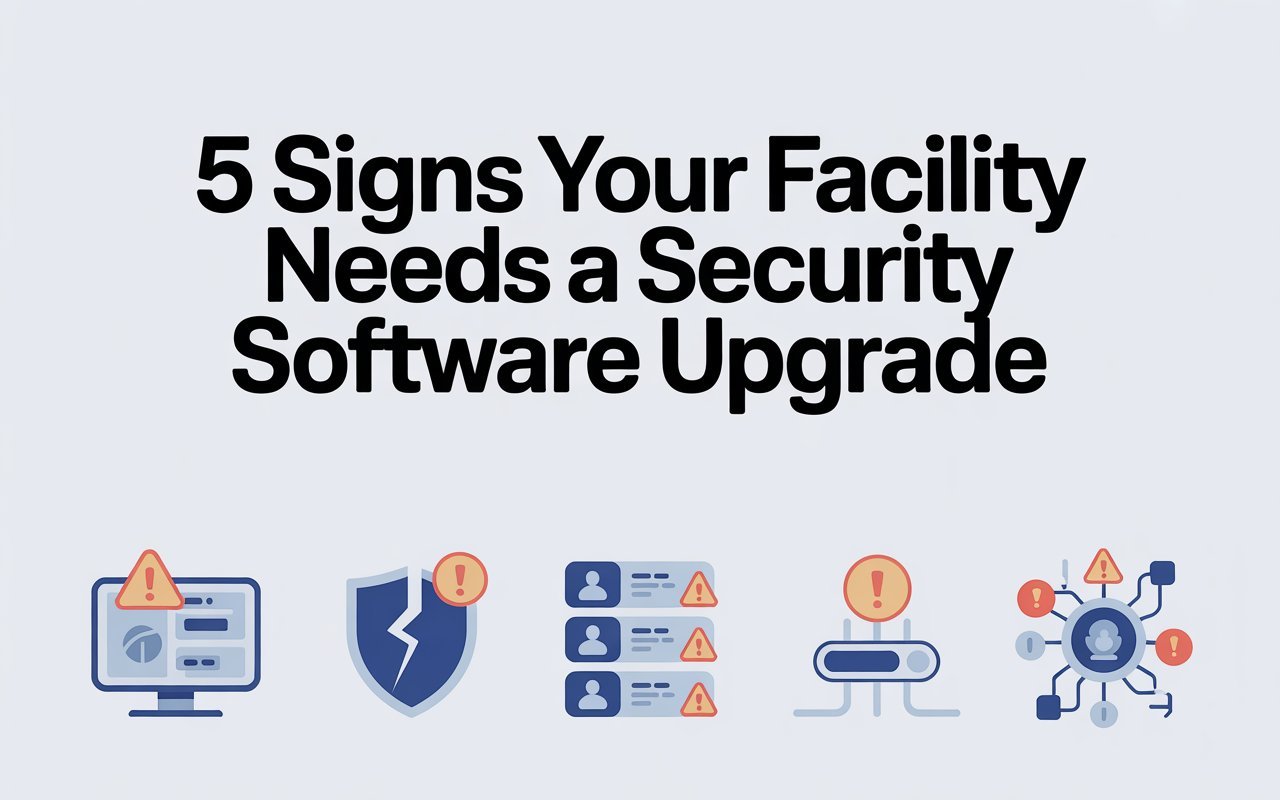
5 Signs Your Facility Needs a Security Software Upgrade
Sign 1: High False Alarm Rates and Alert Fatigue
The symptom: Your security team spends the majority of their shift investigating false triggers — a swaying tree branch, a cleaning robot, a shadow.
Why it matters: Alert fatigue is one of the most dangerous conditions in physical security. When staff desensitize to alarms, genuine threats get overlooked.
The modern solution: AI-powered object classification distinguishes between a wandering animal and a real perimeter breach in milliseconds. Your team responds only to verified threats, reducing false alarm rates by up to 90% in facilities that have upgraded their platforms.
Sign 2: No Centralized Real-Time Visibility
The symptom: Your team logs into three or four separate applications to check cameras, gate access logs, ticketing kiosks, and visitor records.
Why it matters: Fragmented visibility is the primary cause of delayed incident response. If a security event requires cross-referencing multiple systems, critical seconds are lost.
The modern solution: A unified Centralized Control Dashboard consolidates every data stream into a single operational view. This “Single Source of Truth” allows security personnel to monitor all zones, flag anomalies, and trigger automated responses — all from one interface.
Sign 3: Manual Entry and Slow Visitor Processing
The symptom: Queues form at your entrance. Staff manually check IDs, log names on paper, or enter data into disconnected spreadsheets.
Why it matters: Slow entry processing is both a security vulnerability and a brand issue. It creates congestion points where crowd dynamics are unpredictable and fraud is easier to execute.
The modern solution: Self-Service Ticketing Terminals and automated Visitor Management Platforms verify identities using biometrics, QR codes, or RFID wristbands in under two seconds. Facilities using these systems have eliminated manual entry entirely at high-traffic gates.
Sign 4: Inability to Integrate New Technologies
The symptom: Adding a new set of smart turnstiles or biometric wristband printers requires months of custom development or a full system overhaul.
Why it matters: Rigid software architecture does not just slow down upgrades — it makes your facility incompatible with the direction the industry is moving. IoT sensors, biometric devices, and AI analytics tools are now standard expectations, not premium add-ons.
The modern solution: Best-in-class security software is modular and API-ready, designed to connect with RFID readers, smart turnstiles, biometric scanners, and mobile apps without disrupting existing infrastructure. If your current platform cannot do this, it is already obsolete.
Sign 5: No Predictive Data or Operational Analytics
The symptom: Your reporting tells you what happened — after it happened. You have no visibility into crowd density trends, peak entry windows, or behavioral anomalies until an incident occurs.
Why it matters: Reactive security is expensive security. Post-incident responses require more personnel, carry more liability, and damage visitor trust in ways that are difficult to recover from.
The modern solution: Modern platforms generate live heatmaps of crowd density, predict peak entry times using historical patterns, and flag behavioral anomalies automatically. This transforms your security investment from a cost center into a strategic operational tool.
What Makes Security Software “Best-in-Class” in 2026?
For a platform to qualify as the best security software for high-traffic facilities in Saudi Arabia today, it must demonstrate the following validated capabilities:
| Attribute | What It Means in Practice |
| Interoperability | Syncs with IoT devices, RFID wristband printers, biometric scanners, and mobile apps |
| Edge Computing | Processes data at the source (camera or gate) for zero-latency responses |
| SDAIA Compliance | Adheres to Saudi Data and AI Authority standards for data privacy and encryption |
| NCA Alignment | Meets National Cybersecurity Authority guidelines for government and hybrid-cloud deployments |
| Scalability | Expands seamlessly from a single office to a nationwide venue network |
| Open Platform Architecture | Integrates legacy hardware via encoders and APIs, protecting existing capital investment |
Real-World Applications: Which Industries Benefit Most?
Shopping Malls
AI-powered crowd flow monitoring prevents dangerous overcrowding in food courts and high-traffic corridors. Security patrol routes are automatically optimized based on real-time density data.
Event Venues and Sports Stadiums
Wristband and ticketing synchronization ensures only verified attendees access VIP zones. Automated gates eliminate manual checks entirely, processing thousands of visitors per hour without staff intervention.
Government and Defense Facilities
Multi-factor authentication — combining biometrics with encrypted digital passes — secures restricted zones against both physical and digital unauthorized access.
Corporate Offices
Smart visitor management kiosks replace traditional reception desks. Guests check in, receive digital passes, and are notified to their host — all without manual staff involvement.
Healthcare Facilities
Patient tracking, restricted zone access, and staff authentication are managed through a single integrated platform, reducing both security incidents and administrative overhead.
How ATC Implements a Security Upgrade Without Disrupting Operations
A common concern among facility managers is operational downtime during an upgrade. ATC’s structured implementation process is designed to eliminate this risk entirely:
- Site Audit
We identify all existing hardware — cameras, readers, gates — that can be retrofitted rather than replaced, protecting your capital investment. - Logic Integration
Our engineers connect the new backend software to your existing IT infrastructure through secure API bridges. - Phased Deployment
Self-service kiosks, monitoring stations, and access points are brought online in stages, ensuring continuous security coverage throughout the transition. - Staff Training
Your team receives hands-on training to navigate the intelligent dashboard confidently before go-live. - Ongoing Local Support
ATC provides localized technical support within Saudi Arabia — not remote ticketing systems. Our teams are on the ground when you need them.
Frequently Asked Questions
Q: What is the best security software for high-traffic venues in Saudi Arabia?
The best security software for high-traffic venues integrates real-time crowd analytics, automated access control, and visitor management into one platform — while complying with SDAIA and NCA data standards. ATC’s platform is purpose-built for this environment.
Q: Can I upgrade my security software without replacing all my existing cameras?
Yes. Modern open-platform security software integrates most legacy cameras and hardware through specialized encoders and API connections, significantly reducing capital expenditure.
Q: How does AI improve facility security in 2026?
AI enables behavioral analysis — automatically identifying suspicious patterns, unattended objects, and crowd anomalies that human monitors may miss during extended shifts. It also powers predictive analytics that reduce incident rates before events occur.
Q: Is cloud-based security software safe for government facilities in KSA?
Hybrid-cloud solutions that use localized servers and comply with NCA guidelines provide both high security and remote operational accessibility — making them suitable for government and defense use cases.
Q: What is the ROI of upgrading to an automated security system?
ROI is realized through reduced manual labor costs, elimination of ticket and access fraud, lower incident response costs, and improved operational data for long-term facility planning. Most facilities recover their investment within 12–18 months of deployment.
Q: How long does a security software upgrade take with ATC?
Depending on facility size and complexity, ATC’s phased implementation typically takes between 4 and 12 weeks, with zero disruption to daily security operations.
The Bottom Line: Security Is an Investment, Not a Cost
The gap between secured and vulnerable facilities in Saudi Arabia is widening — not because threats are becoming more sophisticated, but because the tools available to counter them have advanced dramatically. Facilities that upgrade now build a compounding operational advantage. Those that delay inherit compounding risk.
Arrow Tech Company (ATC) specializes in transforming legacy security infrastructure into intelligent, integrated, and future-ready platforms. From AI-powered crowd management to SDAIA-compliant digital access systems, we deliver the technology and the local expertise to make your facility both seamless and bulletproof.
Ready to find out where your facility stands?
Arrow Tech Company (ATC) | Riyadh, Saudi Arabia