 xdexygnr@gmail.com
Introduction: The Operational Revolution in the Kingdom
Are you tired of watching your premium guest experience crumble under the weight of endless queues and security bottlenecks? In the high-stakes world of Saudi hospitality and mega-events, nothing kills the “wow factor” faster than a frustrated crowd stuck at a manual check-in point. The core problem is that traditional paper ticketing and manual access control are too slow, easily forged, and completely disconnected from the digital expectations of the modern Vision 2030 consumer. When your staff is overwhelmed and your data is trapped on clipboards, you aren’t just losing time—you are losing revenue, security oversight, and the trust of your most valued visitors.
Here is the solution you’ve been searching for: Arrow Tech Company (ATC) transforms these operational headaches into a seamless, high-tech journey through integrated RFID and NFC wristband ecosystems. By replacing manual checks with “tap-and-go” smart wearables, we eliminate the friction that slows your venue down. Our solution provides real-time crowd analytics, ironclad security through encrypted chips, and a cashless environment that encourages guests to spend more with a simple flick of the wrist. We don’t just provide a band; we provide a secure, scalable digital nervous system that ensures every guest feels like a VIP from the moment they arrive.
Decoding the Entity – What is Radio Frequency Identification?
The Anatomy of an RFID System
At its core, RFID is a wireless system comprised of two main components: tags and readers. The reader emits radio waves and receives signals back from the RFID tag.
In a venue setting, the “tag” is embedded inside a wristband, card, or sticker. The “reader” is often a gate, a handheld device, or an overhead antenna.
Key Frequency Ranges in RFID:
- Low Frequency (LF – 125 kHz): Short range, slow data. Mostly used for livestock tracking or basic building access.
- High Frequency (HF – 13.56 MHz): The “sweet spot” for many proximity applications. NFC lives here.
- Ultra-High Frequency (UHF – 860-960 MHz): The powerhouse of logistics. It can read tags from 10 to 15 meters away.
Why RFID Dominates Crowd Management
If your goal is to prevent a “crush” at the entrance of a 50,000-person concert, UHF RFID is your only choice. It allows for “bulk reading,” meaning a single antenna can identify 100+ wristbands in a single second as people walk through a portal.
The NFC Evolution – Security in Proximity
What Makes NFC Different?
NFC is a specialized subset of HF RFID. It was designed specifically for secure, peer-to-peer communication. Unlike standard RFID, which is a one-way street (Reader talks to Tag), NFC allows for two-way communication.
The “Intentionality” of NFC
The most human element of NFC is intent. To use an NFC wristband, a guest must physically move their wrist within 4cm of a reader. This “deliberate action” is a massive security feature. It prevents accidental payments and ensures that the user is consciously engaging with the digital touchpoint.
In-Depth Technical Comparison
1. Range and Throughput
- RFID (UHF): High prominence in logistics. It creates a “bubble” of detection. You don’t need to see the scanner to be scanned.
- NFC: Low prominence but high precision. You must “touch” the target.
2. Security and Data Integrity
- RFID: Uses UID (Unique Identifier) numbers. While secure for entry, it lacks the advanced encryption layers found in financial-grade tech.
- NFC: Highly popular for Cashless Payments. It supports AES encryption and dynamic rolling codes, making it nearly impossible to “clone” a wristband balance.
3. Cost of Implementation
- RFID: Lower cost per tag, but higher cost for long-range reader infrastructure.
- NFC: Slightly higher tag cost, but significantly lower infrastructure cost because every modern smartphone is an NFC reader.
Technical Comparison: Range, Speed, and Data
|
Feature |
RFID (UHF/Standard) | NFC (Sub-set of RFID) |
|
Communication Range |
Up to 10+ meters (UHF) | Less than 10 centimeters |
|
Data Transfer Speed |
High (Batch processing) | Moderate (Peer-to-peer) |
| Security Level | Standard UID Tracking |
Advanced Encryption / Tokenization |
| Primary Interaction | Passive (Scanning from a distance) |
Active (Intentional “Tap”) |
| Hardware Requirement | Specialized Long-range Readers |
Standard Smartphones or NFC Readers |
Use Cases – Where Technology Meets the Saudi Market
A. The Mega-Event (Riyadh Season Model)
For large-scale events, a Hybrid System is best.
- Entry/Exit: Use UHF RFID gates to track flow and prevent congestion.
- Food & Beverage: Use NFC wristbands for “Tap-to-Pay,” allowing guests to leave their wallets in their cars.
B. The Smart Mall (Jeddah Retail Model)
Shopping malls are evolving into “Experience Centers.”
- Wayfinding: A guest taps an NFC wristband to a kiosk to receive personalized directions to their favorite store via a mobile app link.
- Loyalty: Automated RFID “Welcome Back” messages as a VIP guest walks through the main entrance.
C. Government & Corporate Facilities
In high-security environments, Access Control is the priority.
- Visitor Management: ATC’s security software integrates with wristband printers to issue time-limited NFC bands for contractors, ensuring they can only access specific floors or zones.
The “Phygital” Strategy – Software Integration
Technology is useless without a brain. At Arrow Tech Company (ATC), we focus on the Backend Connectivity.
1. Real-Time Dashboards
Imagine being a venue manager and seeing a “Heat Map” of your facility in real-time. If the RFID sensors show a bottleneck at “Gate 4,” you can re-route staff before a complaint even occurs.
2. API & Mobile Integration
Our Mobile App Development team ensures that the wristband is just one part of the journey. A guest can register their ticket on a website, receive a QR code, print their wristband at a Self-Service Kiosk, and then use that band for everything else.
Step-by-Step Implementation Guide
- Requirement Mapping: Define your “Pain Point.” Is it long lines (RFID fix) or slow payments (NFC fix)?
- Hardware Selection: Choosing the right Wristband Printer (Thermal vs. Digital) and the correct chip frequency.
- Network Setup: Ensuring the venue has the IT infrastructure to handle real-time data syncing between the readers and the cloud.
- Staff Training: Educating ground teams on how to troubleshoot “non-reads” and how to issue replacements using ATC software.
- Data Analytics: Post-event, we analyze the data to optimize the layout for the next cycle.
Strategic FAQ for Facility Managers
Q1: Is RFID safe for people with pacemakers? Yes. Both RFID and NFC operate at low power levels that fall well within international safety standards for human exposure to electromagnetic fields.
Q2: Can I reuse the wristbands to save costs? For silicone NFC bands, yes. They can be sanitized and re-programmed. For fabric or PVC “single-use” bands, the chip is usually disposed of, though many events keep them as souvenirs.
Q3: Does the system work if the internet goes out? ATC designs “Edge-First” systems. Our readers can store transaction data locally and sync it to the cloud once the connection is restored, ensuring zero downtime for your guests.
Q4: How many people can an RFID gate scan per hour? A well-configured UHF RFID gate can process up to 3,000–5,000 people per hour, depending on the width of the entrance.
Q5: Can we customize the wristbands with our brand logo? Absolutely. We offer full-color printing for fabric, vinyl, and silicone, turning a functional tool into a powerful marketing asset.
Conclusion: Partnering with Arrow Tech for a Future-Proof Venue
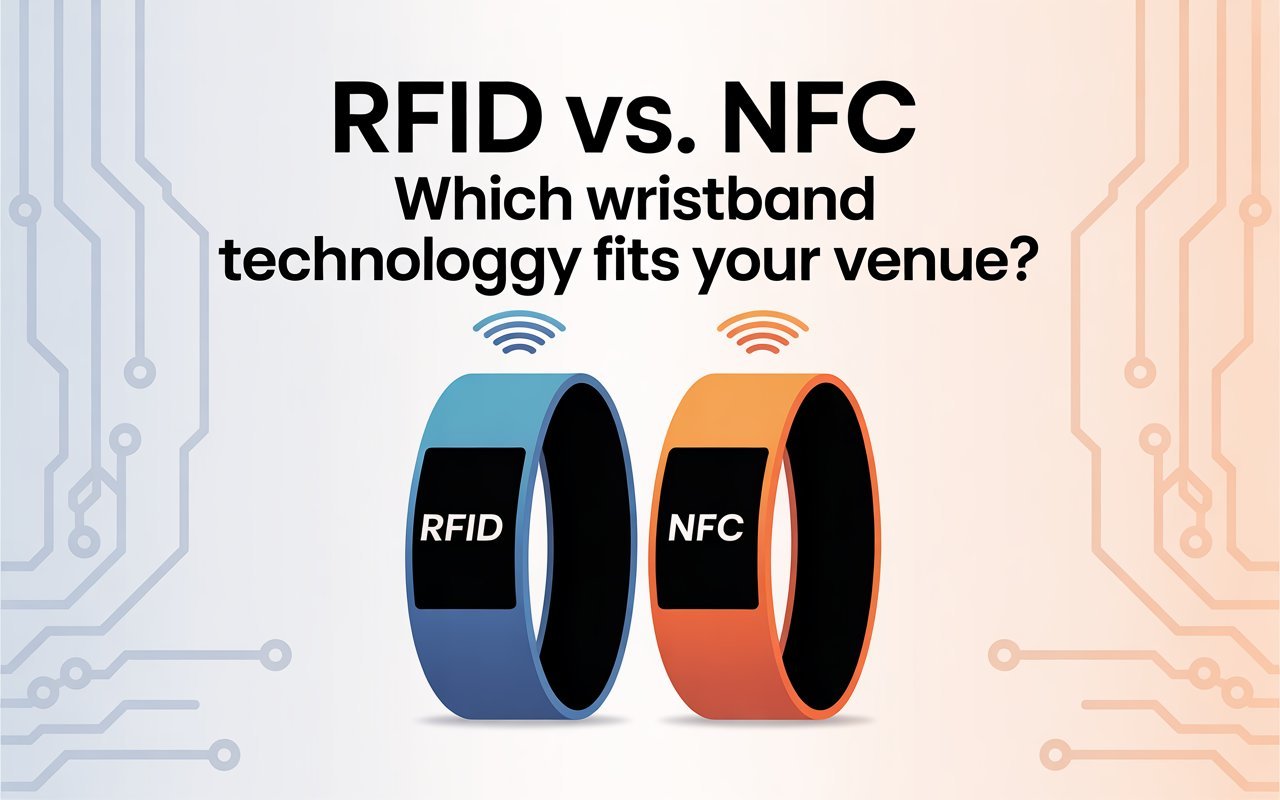
Choosing between RFID and NFC is no longer just a technical preference; it is a high-stakes business strategy that determines the pace of your operational success. In a world where customer experience is the ultimate currency, your venue’s infrastructure must be Smart, Secure, and Seamless to survive and scale. By integrating these intelligent wearables into your ecosystem, you are not just buying a product—you are investing in a future-proof architecture that eliminates human error, maximizes secondary spend, and provides the real-time data needed to lead the Saudi entertainment and corporate landscape.
At Arrow Tech Company (ATC), we specialize in bridging the gap between sophisticated hardware and high-performance software. Whether you are building the next world-class theme park or securing a high-traffic corporate headquarters, we provide the localized expertise and scalable technology to make it happen. Don’t leave your operational efficiency to chance; choose a partner that understands the nuances of the Kingdom’s digital transformation.
Ready to build the future of Saudi operations together? Contact our expert consultants at info@arrowtech.sa to design your custom smart-access roadmap today.