 xdexygnr@gmail.com
The Quiet Revolution Happening at Every Gate, Stage, and VIP Lounge
Picture this: a sold-out music festival, 40,000 attendees, three stages running simultaneously, a VIP lounge, cashless food vendors, and a backstage crew of 200. A decade ago, managing all of that relied on paper tickets, clipboards, ink stamps, and the occasional velvet rope. Today, the entire ecosystem runs off a slim band around your wrist.
Wristband tech has moved from a novelty to the operational backbone of live events — and the shift is accelerating faster than most event organizers realize. The global event wristband market is expanding alongside the broader live events industry, driven by rising expectations around security, guest experience, and payment efficiency.
This article unpacks what modern tech wristbands actually do, why they matter more than ever, and how event organizers, venue managers, and brand marketers are deploying them to solve real problems — from unauthorized entry to slow beer lines.
What Is Wristband Tech?
At its core, wristband tech refers to wearable identification and access-control devices worn around the wrist during events, festivals, conferences, sports games, hospitals, and branded activations. Unlike traditional paper wristbands that simply confirm attendance, tech wristbands embed functional technology — RFID chips, NFC (Near Field Communication) modules, QR codes, or BLE (Bluetooth Low Energy) sensors — directly into the band.
The result is a wearable that simultaneously acts as:
- A secure entry credential (replacing paper tickets)
- A cashless payment terminal (linked to a pre-loaded digital wallet)
- An access tier badge (differentiating general admission from VIP, backstage, or hospitality zones)
- A data collection point (tracking movement, dwell time, and spending behavior)
- A brand touchpoint (custom-printed, color-coded, and tactilely memorable)
The distinction between a paper wristband and a high tech wristband is not cosmetic — it is functional. One is a receipt. The other is a platform.
The Industry Problem Wristband Tech Solves
Fraud, Forgery, and the Paper Ticket Era’s Vulnerabilities
Paper-based access systems have two fundamental weaknesses: they can be duplicated, and they cannot communicate. A photocopied ticket looks identical to the original. A forged stamp passes a visual check. A stolen paper wristband can be transferred. None of these scenarios are detectable at speed, at scale, by a gate agent under pressure.
The consequences are significant:
- Revenue leakage from counterfeit tickets
- Overcrowding risks when more people enter than capacity allows
- VIP access violations that degrade premium experiences
- Long queue times created by manual verification
- No real-time attendance data for safety or operational decisions
Wristband tech resolves each of these problems — not by adding complexity, but by shifting the verification process from human judgment to encrypted digital authentication.
The On-Demand Printing Breakthrough
One of the most practical advances in the wristband tech space is on-demand printed wristbands. Rather than pre-printing thousands of bands months in advance, event operators now use secure, dye-sublimation or thermal printing systems that produce personalized wristbands at the point of guest registration.
This means:
- Guest names, photos, and access tiers are embedded at the time of issuance
- Counterfeit wristbands cannot be created in advance because each band is unique
- Lost or stolen wristbands can be deactivated and re-issued instantly
- Inventory waste is eliminated — you print exactly what you need
On-demand printing, combined with RFID or NFC chip activation at issuance, creates a closed-loop credentialing system that is both operationally efficient and cryptographically secure.
Core Attributes and Features of Modern Tech Wristbands
Understanding wristband tech requires understanding its component layers. Here is a breakdown of the key technical and functional attributes that define the category:
1. RFID vs. NFC: The Technology Inside the Band
RFID (Radio Frequency Identification) wristbands use passive chips that activate when scanned by a reader. They are fast (tap-and-go in under 300 milliseconds), durable, and cost-effective at scale. Most festival wristbands use UHF or HF RFID.
NFC wristbands operate on a 13.56 MHz frequency and allow two-way data exchange — making them ideal for payment processing, loyalty systems, and interactive brand activations. NFC chips are compatible with most modern smartphones, enabling a guest to tap their wristband against a phone to check their balance or share social media content.
QR-code wristbands are the entry-level option — printed codes that require a camera scan. They are lower cost but more vulnerable to screenshot fraud and screen-glare failure.
BLE (Bluetooth Low Energy) wristbands are used in higher-budget applications, offering location tracking, real-time analytics, and personalized push notifications based on where a guest is within a venue.
2. Cashless Payment Integration
The cashless payment function is one of the most commercially significant features of tech wristbands. Guests pre-load a digital wallet (via app, kiosk, or online) and spend by tapping their wristband at vendor terminals.
Benefits include:
- Average transaction time drops from 22 seconds (cash) to under 3 seconds
- Alcohol age-verification can be built into the access layer
- Spending data is captured at a per-guest, per-vendor level
- Lost wristbands can be frozen immediately, protecting guest funds
- Event organizers capture float revenue on unspent balances
3. Access Tiering and VIP Control
High tech wristbands support multi-zone access control with precision. A single wristband can carry multiple access permissions — general admission, VIP lounge, artist hospitality, press area, and restricted production zones — each controlled independently through the same chip.
Access rules can be updated in real time. If a VIP area reaches capacity, the system automatically blocks further entries without any human intervention at the gate.
4. Secure On-Demand Printing
Modern wristband printing systems use dye-sublimation technology to produce full-color, photo-quality bands with embedded security features — holograms, microtext, sequential serialization, and UV-reactive ink. Combined with RFID chip encoding, a printed wristband becomes a unique, non-transferable credential that is visually and digitally authenticated.
5. Real-Time Data and Event Intelligence
Every scan, every payment, every zone entry generates a data point. Tech wristbands feed live dashboards that show event operators:
- Current attendance by zone
- Revenue by vendor in real time
- Crowd flow and congestion alerts
- Per-capita spending and popular item tracking
- Guest re-entry frequency
This is not just useful after the event — it is actionable during it.
Use Cases, Industries, and Real-World Applications
Wristband tech is not a single-industry solution. Its applications span a wide and growing range of sectors:
Music Festivals and Live Events
The origin category. Festivals like Coachella, Glastonbury, and Tomorrowland have used RFID wristbands for over a decade. The wristband has become a brand artifact — guests keep them as memorabilia, extending the festival’s marketing reach far beyond the event itself.
Cashless payment at festivals significantly increases per-attendee revenue. When friction is removed from transactions, spending rises — studies from various festival operators have reported spending lifts of 15–30% after switching to cashless wristband systems.
Corporate Events and Conferences
Conference organizers use NFC wristbands to replace badge lanyards with a more elegant solution. Session check-in, lead capture for exhibitors, networking data exchange, and meal entitlement tracking all run through the same band.
For multi-day events, the wristband eliminates the need for ticket re-validation each morning — guests simply wear the band and move freely within their access permissions.
Sports Venues and Stadiums
Premium stadium experiences now rely on high tech wristbands for hospitality suite access, club-level perks, and VIP parking validation. Season ticket holders can be issued wristbands for home game runs, with loyalty points accumulated automatically through each scan.
Cashless concession stands reduce queue times — a critical factor in improving in-stadium satisfaction scores.
Theme Parks and Attractions
Disney’s MagicBand pioneered the concept of the all-inclusive wristband experience at theme parks — room key, park entry, ride reservation, and payment rolled into a single device. That model has since been adopted and adapted by water parks, zoo ticketing systems, and family attraction operators globally.
Healthcare and Patient Management
In hospital and clinical settings, patient-ID wristbands equipped with barcodes or RFID chips ensure accurate medication administration, track patient movement within wards, and integrate with electronic health record (EHR) systems. Here, the security stakes are not commercial — they are clinical.
Nightclubs and Hospitality
Nightclubs use wristband tech to manage capacity compliance, differentiate table-reservation guests from walk-ins, and enable seamless bar tab management. A guest’s tab opens the moment they tap in and closes when they tap out — no card required.
Comparison: Paper Wristbands vs. Tech Wristbands
| Feature | Paper Wristband | Tech Wristband (RFID/NFC) |
| Counterfeit Resistance | Low | Very High |
| Cashless Payment | No | Yes |
| Real-Time Access Control | No | Yes |
| Multi-Zone Tiering | Limited | Full |
| On-Demand Personalization | Basic | Full (photo, name, tier) |
| Data Analytics | None | Comprehensive |
| Lost Band Recovery | Not possible | Instant deactivation |
| Guest Experience | Functional | Premium |
| Environmental Impact | Single-use paper | Reusable options available |
| Cost Per Unit | Very low | Low to moderate |
The cost gap between paper and tech wristbands has narrowed significantly as production volumes have scaled. For events above approximately 500 attendees, the operational and revenue benefits of tech wristbands typically outweigh the incremental cost within a single event cycle.
Implementation Overview: How to Deploy Wristband Tech at Your Event
Deploying a wristband tech system is a structured process. Here is a practical overview of how it works end-to-end:
Step 1: Define Your Access Architecture
Before selecting hardware, map out your access zones, ticket tiers, and cashless payment requirements. Knowing how many zones you need, which staff need admin override access, and what your peak gate throughput needs to be will determine your reader count and wristband technology choice.
Step 2: Choose Your Wristband Technology
- NFC for payment-heavy, interactive, or consumer-brand activations
- RFID (HF) for fast access control at medium-to-large events
- RFID (UHF) for high-throughput gates at very large venues
- QR-code hybrid for budget-conscious events with lower fraud risk
Step 3: Set Up On-Demand Printing Stations
Configure registration kiosks or staffed printing stations at your entry points. Each station connects to your guest database, pulls up the attendee record, and prints a personalized wristband with the correct chip encoding in under 30 seconds per guest.
Step 4: Configure Cashless Wallet Infrastructure
If deploying cashless payments, set up your pre-load channels (app, website, on-site kiosk), configure vendor POS terminals, and train staff. Establish a clear policy on post-event refunds for unspent balances — this is both a legal consideration and a guest experience factor.
Step 5: Brief Gate Staff and Security Teams
Technology works best when the human layer supports it. Gate staff should understand the system, know how to handle declined reads, and be trained to spot attempted wristband transfers. Security supervisors should have access to the real-time dashboard.
Step 6: Monitor Live and Debrief Post-Event
During the event, monitor your live dashboard for anomalies — unusual access attempts, zones approaching capacity, vendor terminals going offline. After the event, pull your full data report to inform the next edition.
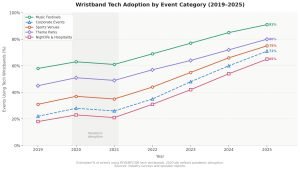
Adoption of Wristband Tech Across Event Categories (2019–2025)
The chart above tracks adoption across all five major event categories from 2019 to 2025, with the 2020 dip reflecting the live events shutdown during the pandemic — and the sharp recovery curve after that tells the real story of how urgently operators moved to upgrade their access systems once venues reopened.
Frequently Asked Questions About Wristband Tech
1. What is the difference between an RFID wristband and an NFC wristband?
Both use radio frequency communication, but they serve slightly different purposes. RFID wristbands are optimized for fast, one-way identification — the chip broadcasts a unique ID when it enters a reader’s range. NFC wristbands support two-way data exchange and work with smartphones, making them better suited for cashless payments, loyalty integrations, and interactive brand experiences. For pure access control at high-throughput gates, RFID is typically faster. For events where the wristband doubles as a payment device, NFC is the standard choice.
2. How does on-demand wristband printing prevent fraud?
On-demand printing means each wristband is produced at the moment of registration, encoded with a unique chip ID, and linked to a specific guest record in real time. There is no batch of pre-printed bands sitting in a warehouse that can be stolen or counterfeited in advance. Additionally, the printed surface can include security features such as holograms, UV-reactive ink, and serialized microtext. Even if someone duplicates the visual design, the chip encoding is cryptographically unique — and a duplicate chip will be rejected at the first scan.
3. What happens if a guest loses their wristband at an event?
This is one of the clearest advantages of tech wristbands over paper tickets. When a guest reports a lost wristband, the operator deactivates that chip ID in the system within seconds. A replacement band is issued with a new chip ID, and the guest’s access permissions and cashless wallet balance are transferred over instantly. No funds are lost. No access is permanently disrupted.
4. Can wristband tech integrate with existing event management or ticketing platforms?
Yes — most enterprise-grade wristband systems are built with open APIs and support integration with major ticketing platforms (such as Eventbrite, Ticketmaster, AXS, and proprietary box office systems), CRM tools, and event management software. Data from wristband scans — attendance, payments, zone entries — can flow directly into your existing reporting infrastructure.
5. Are tech wristbands environmentally sustainable?
This is a growing area of focus in the industry. Single-use RFID wristbands do carry a higher environmental cost than paper bands. However, several manufacturers now offer silicone or fabric reusable wristbands designed for multi-event use. Post-event collection programs and chip recycling schemes are being adopted by larger festival operators. The net environmental picture also needs to account for the paper and plastic waste eliminated by removing printed tickets and cash infrastructure from the event.
6. How much does it cost to implement a wristband tech system?
Costs vary significantly by scale and technology type. At the entry level, QR-code wristbands can cost well under $1 per unit. RFID wristbands typically range from $1 to $4 per unit depending on volume, chip type, and printing quality. The bigger investment is often in the reader infrastructure, software licensing, and cashless payment processing integration. For large-scale events, operators frequently recoup this investment through reduced gate labor costs, increased cashless spending, and data insights that improve future event performance.
7. What is the best wristband tech solution for a small event under 1,000 people?
For smaller events, QR-code wristbands with on-demand printing and a lightweight scanning app often offer the best cost-to-benefit ratio. They require minimal hardware, are easy to set up, and still provide real-time check-in tracking. If cashless payments are a priority even at smaller scale, NFC-enabled bands are available at lower per-unit costs when ordered in smaller quantities. The key is choosing a system that does not require expensive reader hardware installation — cloud-based scanning via smartphones is sufficient for events at this scale.
Conclusion: The Wristband Is No Longer Just an Accessory — It Is Infrastructure
The journey from a paper strip stapled around a guest’s wrist to a cryptographically secure, NFC-enabled, cashless-payment wristband did not happen overnight. It happened because the problems that tech wristbands solve — fraud, slow queues, unauthorized access, limited data, lost revenue — are expensive, persistent, and growing harder to ignore as events scale.
Wristband tech today sits at the intersection of physical security, financial infrastructure, and guest experience design. The best implementations are invisible to the guest — they simply walk in, spend freely, and move between spaces without friction. Behind that seamless experience is a system that is simultaneously tracking capacity, authenticating identity, processing transactions, and generating data that makes the next event better than the last.
If you are still managing access with paper tickets, manual checklists, or ink stamps, you are not just behind on technology — you are operating with a structural disadvantage that affects your revenue, your safety profile, and the experience you deliver to every person who walks through your gate.
The upgrade path is clear, the technology is proven, and the economics are increasingly favorable. Wristband 2.0 is not the future. For thousands of events running right now, it is the present.